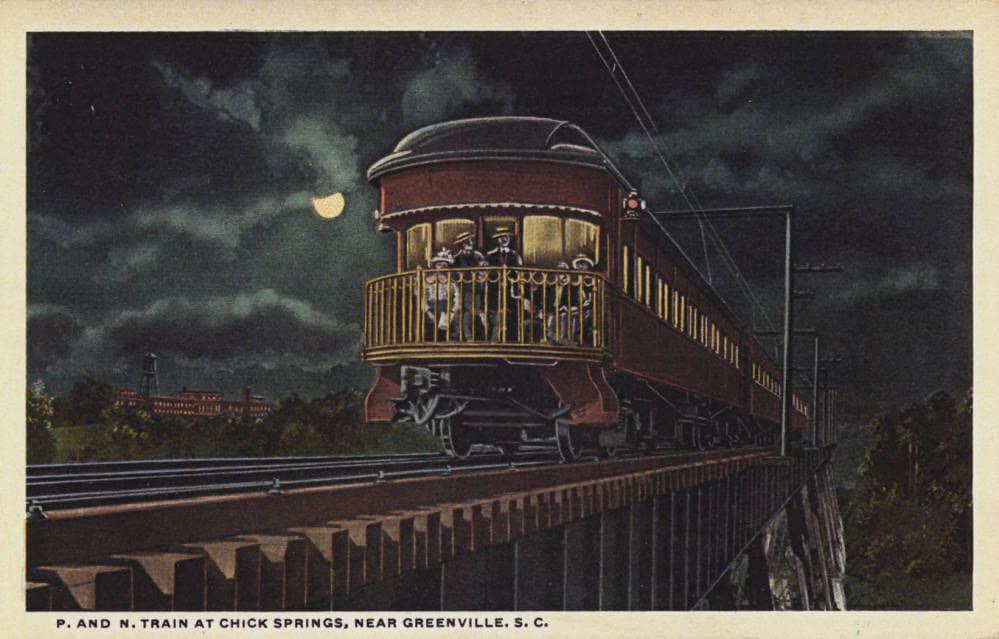
By July 1861, only 37 guests remained. After news of Bull Run, “great excitement” caused even those to leave. Men from the surrounding community formed Company F of the 16th South Carolina Regiment, mustering at Shockley’s Muster Ground. Alfred Taylor tried to buy a substitute for $4,000—paying someone to serve in his place, a common practice under Confederate conscription—but when that failed, he joined near the end and was present at Appomattox.

1861 – 1903
War, Railroad, and a Name That Moved
The hotel burns. The railroad arrives. Every institution migrates from the Springs to the Station, and a mineral spring loses its gravitational pull.
“Chick Springs yields to Taylors. The name had moved.”
On August 28, 1864, seventeen charter members organized a church on the former Crowder land above the springhouse. Miss Nettie Farrow, a Charleston refugee, wrote for the Confederate Baptist, noting “soldiers’ half-clad barefooted wives and children” in the congregation. Meanwhile, Company F fought from Chickamauga to the devastating Battle of Franklin, where General States Rights Gist and 56 men of the company were killed. The congregation would later split amicably—not by dissension but by distance. Seventeen males and thirteen females formed Fairview Baptist Church near the springs, while forty-five males and forty-five females organized Taylors First Baptist Church at the Station.
Alfred Taylor’s Diary: Freeing Slaves, “Great Changing and Shifting”
“Great changing and shifting.”
— Alfred Taylor’s diary, July 1865
Taylor’s diary from April through July 1865 records “watching for Yanks” and hiding things. In June, he went to Thomas Taylor’s house, freed his slaves, and made contracts. By July: “great changing and shifting of Negroes.” By 1867–68, he noted “great excitement about the Union Leagues and Democrats.” The world that had produced the resort was ending.
The deed recorded February 20, 1868, conveyed the property back to William Chick and Martha Chick for $1,854—a fraction of the original $15,000 sale price. But the deed price tells only part of the story. According to Flynn, Mrs. H. L. Chick first satisfied two prior judgments totaling $20,400, then paid Franklin Talbird and John S. Henery $22,944.38 to cancel the mortgage and return the property to family control. Whether the $1,854 deed represents the final payment after those judgments, or the full figures reflect separate accounting, the result was the same: eleven years after the 1857 sale, the land was back in Chick hands. But the hotel was ashes, the guests were gone, and the economy that had supported the resort was destroyed.
Greenville County held a referendum on a $200,000 bond issue to bring the Atlanta and Charlotte Air Line Railway through the county. At the Chick Springs polling place, all 81 votes were in favor. The community at the springs voted unanimously for the very thing that would pull the center of gravity away from them.
Thomas J. Shockley died in April 1862, leaving no will and six minor children. His brother John P. Shockley administered the estate for nearly a decade — hiring out the estate’s enslaved worker, collecting debts, and managing the property through the Civil War. In 1871, the real estate was sold to Thomas Steen. The final settlement, recorded in February 1872, distributed the proceeds among the heirs. Among the names in the estate papers: W.B. Crowder, J.C. Waddill, and — signing as an appraiser on a neighboring estate — Alfred Taylor.
The Railroad Arrives—the Center of Gravity Shifts
On April 26, 1873, the first excursion train from Charlotte reached Greenville—the Greenville Enterprise reported 1,500 people met the train. Four years later, Taylor’s Turnout was established as a station on the Atlanta & Charlotte Air Line Railway. Alfred Taylor got the contract to clear the right-of-way. The shift from Springs to Station had begun—and Taylor himself was the agent of the change.
Every Institution Migrates from Springs to Station
Taylor won a petition battle to reroute the road (1878). The schoolhouse was physically cut into sections, loaded onto wagons, and moved to the Station (1880). The church voted to relocate—57 males, 58 females (1884)—and was renamed Taylors Baptist Church (1887). The post office followed in 1904. A mineral spring that had organized a community for half a century yielded to the railroad stop that bore Alfred Taylor’s family name.
Burwell Chick’s will had placed his Greenville estate — property later estimated at $50,000 — in trust for his daughter Maria H. Thompson during her life, with remainder to her sisters Louisa V. Farr, Wilhelmina Chaplin, and Caroline Hodges. The trustee was Reubin S. Chick. Years earlier, during the federal judgeship of James L. Orr, Maria Thompson had brought an action against her trustee and obtained a decree ordering the sale of the estate; the property was sold to various parties under that order. Maria died around 1880. In December 1883, Louisa Farr, Wilhelmina Chaplin, and Asa Hodges (husband of the deceased Caroline) sued Sheriff P. D. Gilreath to recover the property, alleging that they had never been made parties to the original proceeding and were not bound by the decree. The suit exposed the litigation that had pulled the resort into a Master’s sale — and set the stage for the property Westmoreland would buy two years later.
Sources
After Reubin Chick’s death in 1881, George Westmoreland—an Atlanta lawyer—purchased the undivided half interest at a Master’s sale for $2,750, then bought the other half. He built a smaller hotel and cottages and advertised “Summer Health Resort, Chick Springs, Taylor’s Station.” But by June 1885, a visiting “invalid” found no hotel operating—only private boarding with a local family. The spring still drew people; the infrastructure kept failing.
In the Cotton Growers Association listing of 1897, the township committee appears as “CHICK’S SPRINGS (Taylors Station)”—the old name in the heading, needing the new one in parentheses to locate itself. That parenthetical is the entire transition captured in a single line. By 1904, the post office would be renamed from Chick Springs to Taylors. The name had moved.