Twenty inches of rain fell in twenty-two hours. Chick Springs lake burst its banks and floodwater swept through the property. Alfred Taylor's old bridge held. It was the first major flood at the site—twenty-one years before the Highway 29 culvert would cause a far worse one.
1907 – 1932
Three Hotels, a Military Academy, and a Hospital
The hotel burns again. What follows is a rapid-fire cycle of reinvention—a replacement hotel, a ginger ale company, a military academy, a sanitarium—each one smaller than the last.
Sam A. Pegram of Charlotte, “one of the best hotel men in the country,” leased Bull’s rebuilt 42-room hotel for the 1910 season. He renovated extensively: new carpets, improved walkways, a rock fence around the springhouse. The Sunday dinner menu was published in the newspaper—Cream D’Vaullie, Broiled King Pompano, Roman Punch between courses, alongside Country Fried Spring Chicken and Hot Cone Pone. “All home grown.” A Greenville optometrist held office hours at the hotel before the season opened—it was still a community hub.
Sam A. Pegram
◆
1913–16
CommerceLoss
Arnold Builds a 100-Room Hotel—Then WWI Empties It
J. Thomas Arnold and Associates bought the property and built a 100-room hotel that opened to a full house. Within days of the news from Europe, it emptied. Arnold also manufactured Chick Springs Ginger Ale, distributed through jobbers across the Carolinas, Georgia, and Florida. In April 1916, the enterprise was sold at public auction for $48,000. Four-fifths interest went to Stroud, Berry, and Bull. The Chick Springs Water Company was incorporated with $100,000 in capital stock.
J.A. Bull
◆
1916–17
FireLossMilitary
Military Academy Opens in the Hotel—Closes Within Two Years
Major W.D. Workman served as commandant and C.B. Martin as superintendent. The 100-room hotel became barracks; the annex held classrooms and a chapel; the pavilion became a gymnasium. In October 1917, a $25,000 annex burned—faulty wiring. The Greenville fire department came “in autos but could render no assistance.” Cadets went on strike during an unusually cold December. The academy closed permanently. Three fires in 55 years.
Camp Sevier, the WWI training camp established between Chick Springs and Greenville on the Southern Railway, brought new visitors to the area. The Water Company repaired the hotel and leased it to a New York man as an all-year resort. After one successful season, he departed abruptly, leaving the hotel full of guests. Bull closed the Springs.
J.A. Bull
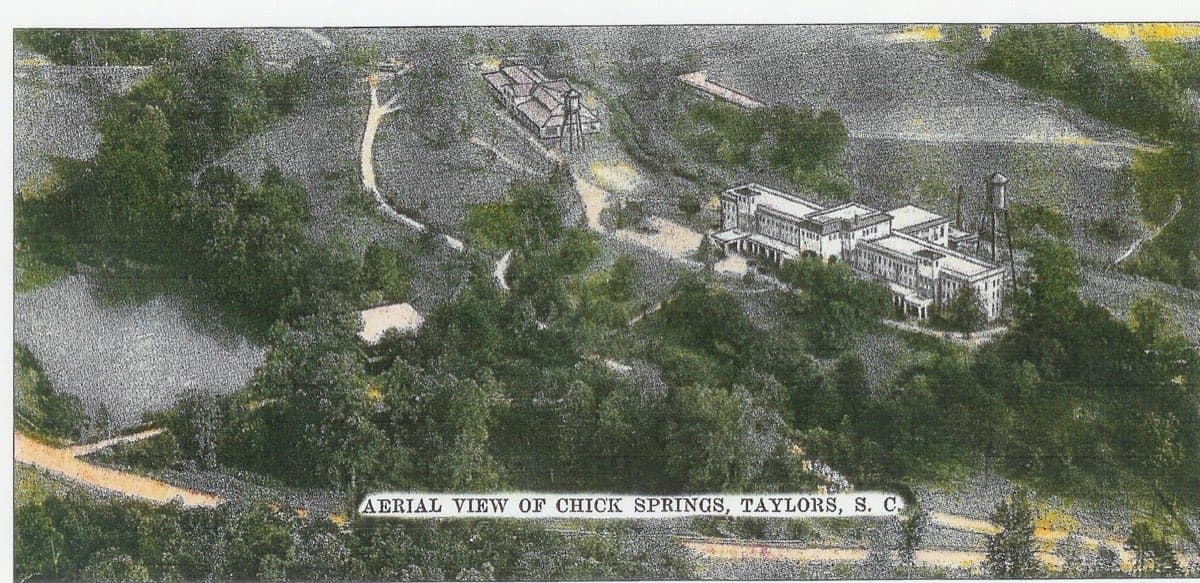
On February 15, 1919, the Greenville News reported that J.A. Bull and Dr. B.B. Steedly of Spartanburg had signed a contract to convert the Chick Springs Hotel into a modern clinic and sanitarium. Bull invested $50,000, Steedly $25,000, and Greenville citizens were asked to raise an additional $50,000—capital stock totaling $250,000. The Greensboro Chamber of Commerce gave its full endorsement. The announcement promised “one of the most modern and complete clinics in the South,” with an opening target of June 1. It was the last great institutional bet on the property.
Dr. B.B. SteedlyJ.A. Bull
◆
1919–32
MilestoneMedicalLoss
Steedly Clinic and Sanitarium—the Last Institutional Chapter
Steedly incorporated the clinic in March 1919 with $250,000 in capital—$50,000 from Bull, $25,000 from Steedly himself, and the rest raised through Greenville and Greer citizens. The four-story hotel was remodeled in Spanish architecture with white columns. The clinic opened with 60 patients and established a state-rated nursing school. It was promoted as rivaling Johns Hopkins. On January 12, 1932, Steedly suffered a cerebral hemorrhage at 1 AM while visiting a patient and died hours later. The clinic closed that December. It was the last institution to occupy the resort buildings. Within five years, the hotel would be razed and the property fragmented.
Dr. B.B. SteedlyJ.A. Bull